


Electronics Manufacturing Quality Assurance for PCBA and Box Build Assembly
Quality assurance in electronics manufacturing begins before production and continues through material control, process verification, inspection, testing, final release, and traceability. At REGULUS, we apply documented quality controls to PCB assembly and box build projects based on product specifications, manufacturing requirements, testing criteria, and agreed acceptance standards.
Our ISO 9001-certified quality management system provides the framework for production control, quality records, corrective actions, and continuous improvement, while project-specific requirements define how these controls are applied to each build.
Quality Assurance Workflow for Electronics Manufacturing
Our electronics manufacturing quality assurance workflow establishes quality requirements before production and applies defined control points through manufacturing, final release, and quality follow-up. The specific inspection, testing, and approval requirements depend on the product and agreed project scope.

1. Quality Requirements Review
Before production preparation, we review applicable BOMs, drawings, specifications, material requirements, inspection criteria, testing requirements, and other defined quality requirements.

2. Sample / Prototype Validation
When samples or prototypes are required, applicable materials, dimensions, assembly quality, functionality, and other defined validation items are reviewed against the agreed requirements.

3. Customer Approval & Production Release
Sample or prototype inspection and test results are reviewed before production release. When customer approval is required, applicable samples, reports, or validation results are submitted for confirmation before mass production proceeds. Open engineering or quality issues that could affect production are addressed before release.

4. Incoming Material Verification
Components, PCBs, mechanical parts, cables, and other incoming materials are checked against applicable specifications before being released to production.

5. In-Process Verification
Applicable manufacturing processes are monitored against defined work instructions, process conditions, and quality requirements while production is in progress.

6. Final Verification & Shipment Release
Finished products are verified against applicable functional, cosmetic, labeling, packaging, quantity, and shipment requirements before release.

7. Quality Records, Traceability & Continuous Improvement
Inspection and test records, production traceability, nonconformance information, corrective actions, and relevant quality data are maintained to support issue investigation, quality review, and continuous improvement.
Quality Control Functions and Responsibilities
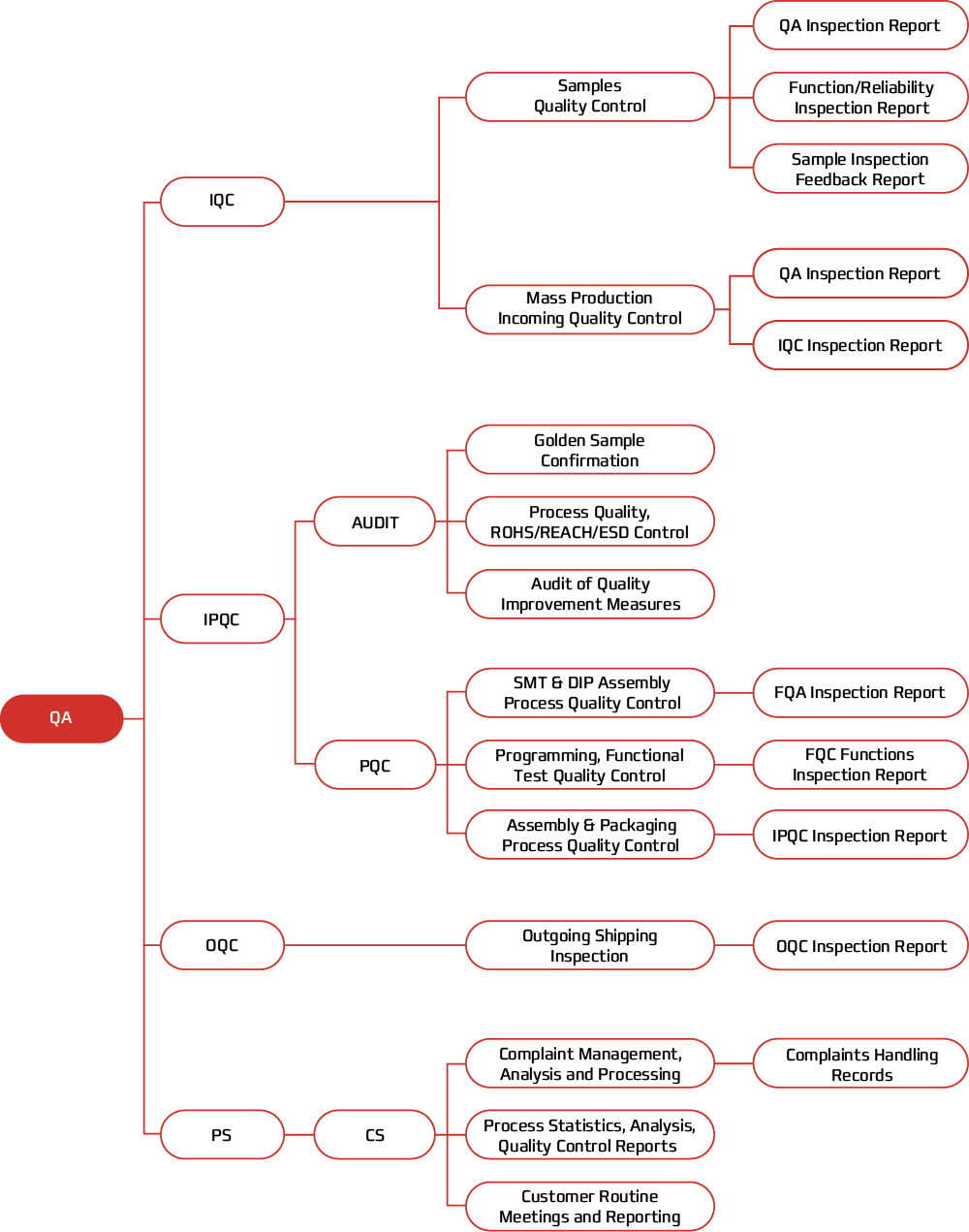
At REGULUS, quality responsibilities cover incoming materials, production processes, outgoing inspection, and post-production follow-up. Our QA structure combines inspection, process control, quality reporting, and customer-quality activities so that issues can be identified and managed at the appropriate manufacturing stage.
IQC — Incoming Quality Control
IQC covers incoming material verification for mass production and applicable quality checks during the sample stage. Sample inspection may include dimensional, functional, reliability, and other defined verification items, with records maintained as required.
OQC — Outgoing Quality Control
OQC performs final outgoing inspection before shipment, verifying applicable product, functional, labeling, packaging, quantity, and release requirements.
PS & CS — Post-Sales Quality and Continuous Improvement
Post-sales quality activities include complaint review, corrective-action follow-up, quality-data and process-statistics analysis, and regular customer quality communication and reporting.
IPQC — In-Process Quality Control
IPQC manages production quality through process auditing and production quality control.
-
AUDIT — Process Standards and Compliance:
Confirms golden sample requirements, applicable work instructions, process controls, RoHS / REACH and ESD requirements, and follow-up of defined quality improvement measures.
-
PQC — Production Quality Control: Monitors SMT and THT / DIP assembly, programming, functional testing, assembly, and packaging for production deviations and quality issues.
Applicable audit and production inspection records are maintained according to the manufacturing and quality plan to support process review and follow-up.

Inspection and Testing for PCB Assembly and Box Build
Inspection and testing methods are selected according to the product design, assembly process, component types, functional requirements, and agreed acceptance criteria.
For PCB assembly, applicable controls may include SPI, AOI, X-ray inspection, visual inspection, electrical testing, and functional testing. For box build projects, verification may also cover wiring, mechanical assembly, programming, product functions, and system-level testing.
Detailed PCB assembly inspection and testing capabilities are available on our PCB Assembly Capability page.
Environmental or reliability testing can also be arranged when required by the product specification or validation plan. See our Reliability Testing Equipment page for additional testing capabilities.
Quality Records and Traceability
Quality records provide documented evidence of the inspection, testing, and control activities performed during manufacturing. Required records and reporting are defined according to the product, production stage, and agreed customer requirements.
Depending on the project scope, documentation may include:
-
Inspection & Test Records: Applicable sample, incoming, in-process, final inspection, and testing results.
-
Production & Revision Traceability: Information linking production records with relevant product, material, process, or revision data.
-
Nonconformance Records: Information used to document, review, contain, and follow up on identified quality issues.
These records provide a traceable basis for manufacturing review and quality investigation when required.

Quality Standards and Compliance Controls
REGULUS applies quality, manufacturing, material, and compliance controls according to the project scope and applicable requirements. Because manufacturing standards, chemical regulations, market-specific requirements, and responsible-sourcing policies serve different purposes, each is managed according to its relevant scope.
Quality and Manufacturing Controls
Provides the framework for documented quality procedures, manufacturing controls, records, corrective actions, and continuous improvement.
Applicable IPC workmanship criteria can be incorporated into PCB assembly acceptance requirements according to agreed project specifications.
ESD-sensitive components and electronic assemblies are handled under defined ESD-control requirements during applicable manufacturing processes.
-
Customer-Specific Requirements
Drawings, approved samples, inspection criteria, testing procedures, reporting requirements, and other agreed specifications can be incorporated into project quality controls.
Regulatory & Responsible Sourcing
Applicable chemical-substance requirements are managed according to regulatory and project-specific conditions, including leaded SnPb assembly where required.
REGULUS maintains a TSCA compliance statement for PCB assemblies based on raw-material conformity survey results under TSCA Section 6(h).
For products intended for California, applicable Prop 65 warning requirements are reviewed before shipment; required label instructions are provided by the customer.
Our Conflict Minerals Policy addresses responsible sourcing of tin, tantalum, tungsten, and gold (3TG) through supplier requirements.
Define Quality Requirements Before Production
Clear quality requirements help establish consistent inspection criteria, testing methods, documentation, and acceptance conditions before manufacturing begins.
For a PCB assembly or box build RFQ, provide the required project documents together with the applicable quality and testing requirements. We will review the manufacturing scope, quality requirements, and project conditions as part of the quotation and production-planning process.
Quality Assurance FAQs
- 01
- 02
- 03
- 04