

Conformal Coating Services for PCB Assembly Protection
Conformal coating is a thin protective layer applied to assembled printed circuit boards to help protect PCB assemblies from moisture, dust, chemicals, contamination, and other environmental exposure.
REGULUS provides automated conformal coating as a post-assembly process for PCB assembly projects. Coating material, coating areas, masking or keep-out requirements, target thickness, application parameters, curing conditions, and inspection criteria are defined according to your product design, operating environment, and protection requirements.
Why Conformal Coating Is Used for PCB Protection
Applying conformal coating creates a protective barrier between the PCB assembly and environmental contaminants. By limiting exposure to moisture, condensation, dust, chemicals, and other contamination, the coating can reduce corrosion risk and help maintain insulation and electrical performance under defined operating conditions.
The effectiveness of the coating depends on the selected material, surface preparation, coverage, thickness, curing process, PCB geometry, and service environment. When integrated into the manufacturing process with appropriate inspection and validation, conformal coating can support product stability and long-term protection without the additional bulk associated with full encapsulation.
Conformal Coating Process Capabilities
Our conformal coating process can be configured according to your PCB assembly design, required protection, coating material, production volume, and inspection requirements:
-
Coverage & Keep-Out Requirements: Coating areas, uncoated areas, connector protection, masking, and other keep-out requirements are defined according to the PCB assembly.
-
Coating Thickness Control: Target coating thickness and applicable inspection criteria are defined according to the selected material and project requirements.
-
Material & Environmental Requirements: Coating materials can be reviewed against specified RoHS, halogen-free, low-VOC, dielectric, chemical-resistance, or other project requirements.
-
Prototype to Volume Production: Coating parameters can be established and maintained from engineering builds through ongoing production.
-
Inspection Requirements: Coverage, appearance, thickness, adhesion, and other applicable coating criteria can be verified according to the agreed project requirements.
-
Controlled Material Use: Selective coating can apply material only to defined areas where appropriate, helping reduce unnecessary coating use and overspray.
Conformal Coating Material Properties
Conformal coating materials differ in their electrical, environmental, mechanical, and processing characteristics. Acrylic, urethane, epoxy, silicone, Parylene, and nanocoating systems provide different combinations of the following properties:
-
Dielectric Properties: Electrical insulation for conductors, components, and other exposed electrical features.
-
Chemical & Moisture Barrier: Resistance to humidity, condensation, contamination, and selected chemical exposure.
-
Biocompatibility & Biostability: Specific qualified coating materials, including certain Parylene grades, can support applications requiring documented biocompatibility.
-
Ultra-Thin Conformal Coverage: Parylene and other applicable coating systems can provide thin coating coverage across exposed surfaces and complex component geometries.
-
Complex Geometry Penetration: Vapor-deposited coatings such as Parylene can reach narrow spaces and difficult-to-access areas around components.
-
High-Temperature Performance: Certain Parylene grades may support short-term exposure up to 450°C, depending on the specific material specification.
-
UV Stability: Resistance to ultraviolet exposure varies according to coating chemistry and formulation.
-
Barrier Protection: Selected coating systems can provide additional protection for sensitive electronic components and structures.
-
Surface Functionalization: Specialized coating materials and processes can provide application-specific surface properties where required.
Actual performance depends on the specific coating chemistry and grade and should be confirmed against the applicable material specifications. Parylene uses a vapor-deposition process rather than the automated liquid selective coating process described later on this page.
How to Select the Right Conformal Coating Material
Once the required protection and operating conditions are defined, coating selection should consider how the available material properties match the product and manufacturing requirements. Key factors include:
-
Operating temperature and humidity
-
Exposure to chemicals or contaminants
-
Required insulation and dielectric performance
-
Mechanical stress and vibration conditions
-
Maintenance and rework needs
These factors should be reviewed together with process compatibility, application method, applicable material requirements, and project cost before final material selection.
Conformal Coating Material Comparison
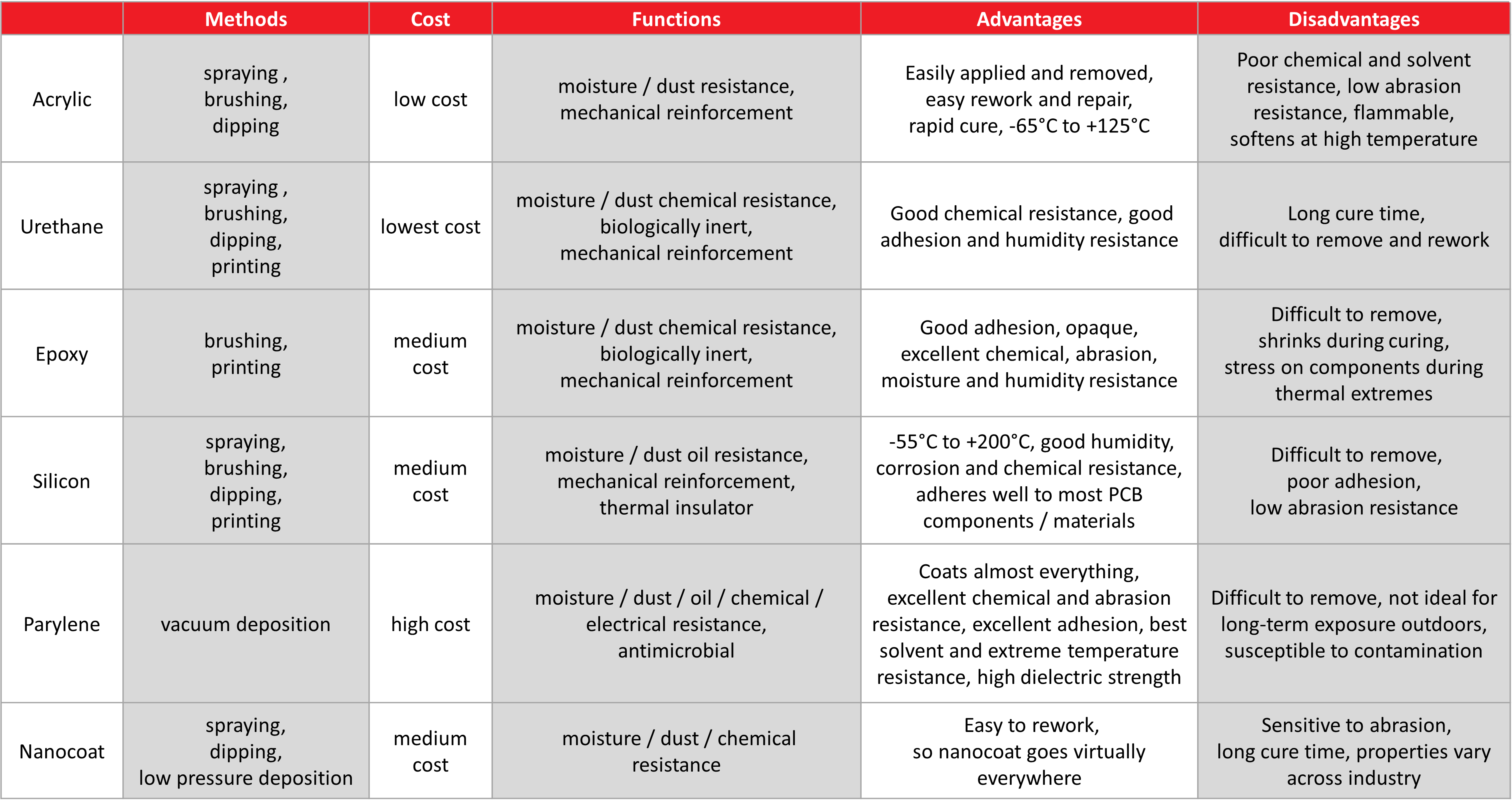
* Material properties, operating limits, curing methods, application processes, and rework characteristics vary by formulation and supplier. The specific material technical data should be reviewed before final production selection.
Environmental Testing & Coating Verification for PCB Assemblies
Environmental testing and coating verification can be defined according to your product requirements, expected operating conditions, and agreed acceptance criteria. Available evaluation and verification methods can include:
-
Thermal Cycling & Temperature Shock Testing: Evaluates coated PCB assemblies under repeated or rapid temperature changes.
-
Humidity & Moisture Resistance Testing: Assesses performance under defined humidity or moisture exposure conditions.
-
Salt Spray & Corrosion Testing: Evaluates resistance to specified corrosive environments.
-
Adhesion & Coating Thickness Inspection: Verifies coating adhesion and thickness against the applicable material and project requirements.
-
Visual & UV Inspection for Coating Coverage: Checks coating presence, coverage, missed areas, and other visible application conditions.
Test and inspection results can be evaluated against the agreed conditions and acceptance criteria to verify the coating process and assess the coated PCB assembly under the specified environmental conditions.
Circuit Boards After Environmental Testing
(Humidity Exposure and Salt Spray Tests)

Applications of Circuit Board Conformal Coating
Conformal coating is used across electronic products that require protection from environmental exposure or specific electrical and material performance characteristics.
Electronics
Conformal coatings are used on circuit boards, LEDs, ferrite cores, and other electronic assemblies and packages exposed to moisture, contamination, or other environmental conditions. Specialized coating technologies such as Parylene are also used for wafers, MEMS devices, lab-on-chip systems, and electrowetting applications where thin coating coverage or access to complex geometries is required.
Automotive
Automotive electronics can be exposed to humidity, fluids, gases, chemicals, contamination, temperature variation, and vibration. Conformal coating is therefore used on sensors, circuit boards, controllers, and other electronic assemblies where these environmental conditions need to be considered. The applicable coating system depends on the product location, operating temperature, chemical exposure, mechanical conditions, and qualification requirements.
Military / Avionics / Aerospace
Conformal coatings are used in avionics, military vehicles, aerospace electronics, and related systems where assemblies may be exposed to dust, sand, moisture, temperature changes, or specified chemical environments. Coating material, thickness, application method, and qualification requirements should be defined according to the product specifications and intended service conditions.
Medical
Conformal coatings can be applied to medical electronics exposed to moisture, biofluids, contamination, or other conditions that could affect sensitive electronic assemblies. Certain qualified Parylene grades and other specialized coating materials are also used in applications such as cochlear implants, pacemakers, neurostimulation devices, and other medical products. These applications require material-specific biocompatibility documentation and applicable product-level regulatory review.
Automated Conformal Coating Equipment & Process
Automated conformal coating equipment used for these projects supports vision-assisted alignment, programmable coating paths, controlled spray or dispense application, programmable conveyor adjustment, and repeatable positioning for defined coating areas. The equipment can also support UV-assisted inspection of the coating application process.
Coating programs and application parameters are configured according to the PCB design, selected coating material, required coverage, keep-out areas, and production conditions.
How the Conformal Coating Process Works
-
Preparation – The PCB assembly is prepared and positioned. Masking or keep-out protection is applied where required, and process parameters are configured.
-
Vision Alignment & Path Setup – Vision-assisted alignment is used to establish the PCB position, and the programmed coating path defines the areas to be processed.
-
Automated Coating Application – Spray or dispense valves apply coating to the specified areas according to the programmed path and application parameters.
-
Curing / Drying – The applied coating is cured or dried according to the selected material and process requirements.
-
Inspection – Coating coverage, thickness, appearance, and other applicable acceptance criteria are verified according to the project requirements.
The automated process supports uniform coating coverage and controlled material application, helping reduce unnecessary material use while improving consistency and production efficiency. Defined application paths and process parameters also help maintain repeatable coating results and reduce the risk of coating defects.


Start Your Conformal Coating Review
Preparing a conformal coating RFQ? Please provide your PCB assembly drawings or board data, required coating and keep-out areas, preferred coating material or required properties, target thickness, quantities, curing and inspection requirements, applicable environmental testing requirements, and target schedule.
If the coating material has not yet been selected, please provide the expected operating temperature and humidity, chemical exposure, insulation requirements, mechanical conditions, and rework needs so that applicable coating options can be reviewed.
PCB Conformal Coating FAQ
- 01
- 02
- 03
- 04
- 05