Case Study
REGULUS has years of electronics manufacturing experience across radio communication, consumer, industrial, safety, tracking, and medical electronics. This case study shows how our box build assembly services manage PCBA integration, electro-mechanical assembly, testing, final assembly, and logistics for a professional radio communication device.
Box Build Assembly Case Study for Professional Radio Communication
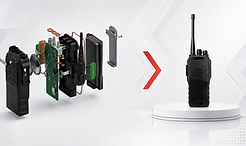
This box build assembly case study shows how REGULUS, a Taiwan-based Electronic Manufacturing Services (EMS) provider, delivered turnkey manufacturing services for a professional-grade digital transceiver used in radio communication. In this project, we converted a complex electronic product into a manufacturable, testable, and delivery-ready device.
The transceiver combined analogue and digital communication functions in a compact product structure with electronics, mechanical parts, and battery components. Our manufacturing scope covered design and DFM review, product-level manufacturing, system-level testing, packaging, and delivery preparation.

Project Snapshot: Digital Transceiver Manufacturing Scope
This snapshot summarizes the box build manufacturing scope for this professional digital transceiver project.
-
Product Type: Digital transceiver
-
Industry: Professional radio communication
-
Application: Multi-band analogue and digital communication
-
Service Scope: Turnkey box build assembly services for an OEM project
-
Manufacturing Scope: Design analysis, Design for Manufacturing (DFM) review, PCB assembly, mechanical parts manufacturing, battery pack production, electro-mechanical assembly, programming, testing, debugging, environmental testing, packaging, and logistics
For our customer’s sourcing, engineering, and product teams, this project required manufacturing decisions across RF communication functions, mechanical enclosure requirements, battery integration, accessory interfaces, and system-level testing before delivery.
Customer Requirements for the Radio Communication Device
REGULUS reviewed the customer’s product requirements and translated them into manufacturing, integration, and testing considerations. The radio communication device combined communication capability, security and encryption, GPS and emergency functions, user operation and audio, accessory connection, and charging requirements within one compact product.
The customer requirements can be grouped into five key areas:
Communication Capability
-
Multi-band analogue and digital transceiver support
-
Zigbee-based mesh networking communication
-
Cross-band communication between VHF/UHF and Hi-UHF bands
For manufacturing, these requirements affected PCB assembly planning, RF-related interface placement, internal connection layout, antenna or module integration, and product-level testing.
Security and Encryption
-
AES/DES cryptographic protection for digital transmission modes
-
End-to-end and air interface encryption support
These requirements increased the importance of programming, configuration control, testing, and functional verification during the manufacturing workflow.
GPS and Emergency Functions
-
Embedded GPS receiver with a fully integrated high-accuracy GPS module and built-in antenna
-
Dedicated emergency call button with programmable call destination and GPS location
These features required attention to GPS module integration, antenna-related placement, emergency button fit, software or firmware configuration, and product-level functional testing.
User Operation and Audio
-
High-quality audio
-
Dedicated function buttons for loudspeaker muting, TMO-to-DMO mode switching, priority calls, and dispatcher calls
These requirements affected function button integration, audio component installation, operation verification, and final product inspection.
Accessory Connectors and Charging
-
Side and bottom mounted accessory connectors
-
Built-in battery charger
These requirements affected connector placement, mechanical fit, battery pack integration, charging interface verification, and electro-mechanical assembly consistency.
REGULUS Box Build Assembly Scope
For this OEM project, REGULUS provided box build assembly services that went beyond installing parts or placing a completed PCBA into an enclosure. Our role covered the complete manufacturing process, including design and process optimization, manufacturing preparation, prototype build and validation, trial run, and mass production.
Engineering and Production Preparation
We prepared the project for production by reviewing production feasibility, selecting manufacturing processes, developing tooling, and validating the build.
-
Design-to-Production Analysis: We evaluated whether the product design could move into repeatable manufacturing, including product structure, material needs, assembly sequence, testing needs, and production feasibility.
-
Production Technology Selection: Our team selected suitable processes based on the product’s materials, mechanical structure, functional requirements, and expected production conditions.
-
Alternative Technology Testing: When needed, we compared or verified different material and process options before applying them to the manufacturing plan.
-
Molds and Tools Development: We developed molds and tools for custom mechanical components and assembly conditions.
-
Pre-Production Prototyping: We built pre-production prototypes to validate engineering and assembly conditions.
-
Trial Run: We conducted a small-batch trial run to verify production flow, assembly sequence, testing requirements, and process repeatability before production.
Read More About Engineering and Design Solutions
Turnkey Manufacturing and Final Assembly
We moved the project from prepared components and verified electronic functions into product-level assembly, environmental testing, and delivery preparation.
-
PCB Assembly: We handled component sourcing, PCB fabrication, and PCB assembly before the completed boards moved into product-level integration.
-
Mechanical Parts Manufacturing: We manufactured custom mechanical parts for the housing, internal structure, interface areas, and protective elements.
-
Battery Pack Production: The project included Li-polymer and Li-manganese battery pack production for the product’s power requirements.
-
Programming, Testing, and Debugging: We performed programming, functional testing, and debugging to verify electronic operation before final product assembly.
-
Product Final Assembly: We integrated the PCBA, custom mechanical parts, battery packs, connectors, interface parts, and accessories into the final product configuration.
-
Environmental Testing: We conducted environmental testing for the transceiver, batteries, and accessories to verify reliability and quality under real-use conditions.
-
Packaging and Logistics Preparation: After environmental testing and final inspection, we prepared the completed product for packaging, logistics, and shipment readiness.
Materials and Manufacturing Technologies Used
This project used multiple materials and production technologies because the digital transceiver combined electronics, mechanical structures, protective interface parts, surface treatments, EMI-related requirements, PCB and FPC materials, battery components, and final product assembly. For box build manufacturing, each material and process had to be considered for fit, durability, electrical performance, protection, manufacturability, and assembly consistency.

Housing and Other Mechanical Parts
-
PC/ABS housing materials
-
Steel, aluminum alloy, nickel silver, and stainless steel metal parts
-
ABS, PET, TPE, TPEE, transparent PC, and other plastic parts
These materials were used for the product housing, structural components, internal mechanical parts, interface areas, and protective elements. They affected product durability, part fit, mechanical strength, appearance, tooling requirements, and final assembly conditions.
Silicone, Rubber, Foam, and Protective Materials
-
Silicone and rubber parts
-
EVA foam with adhesive tape
-
Conductive foam
-
Gaskets or protective interface materials
Inside the device, elastic, cushioning, sealing, and protective materials were used to manage protection, fixation, isolation, and conductive contact requirements. These parts helped the housing, PCBA, connectors, and accessories maintain proper fit and assembly consistency under real-use conditions.
Surface Treatment and EMI Considerations
-
Nickel plating
-
Gold plating
-
Black oxide
-
Black zinc
-
EMI coating
-
Surface painting and coating
Surface treatments were used for appearance, corrosion resistance, surface protection, conductive contact, and functional requirements. EMI coating and related conductive surfaces helped address shielding and contact performance where required by the product design.
PCB and FPC Materials
-
Rigid PCB: FR4 High Tg laminate with immersion gold
-
Flexible Printed Circuit (FPC): Polyimide FPC materials with gold surface finish
These rigid PCB and FPC materials provided the electronic foundation and flexible internal connection needed for a compact digital transceiver. Together, they helped meet requirements for stable assembly, insulation, heat resistance, solderability, and reliable electrical connection.
Production Technologies
-
Secondary machining
-
Programming, testing, and debugging
-
Final assembly and packing
These production technologies were used to form the housing, mechanical parts, and protective components, perform secondary processes such as polishing, prepare electronic components, add and verify product functions, complete final assembly, inspect the finished product, and prepare it for shipment.
Engineering and Manufacturing Challenges in the Box Build Assembly Project
The main challenge of this box build assembly project was not a single manufacturing step. The digital transceiver required electronic assemblies, mechanical parts, battery packs, interface components, audio components, accessories, and multiple materials to fit and function together inside one compact professional communication device.
Key challenges included:
-
Integrating Multiple Parts Into a Compact Device: The product required PCBA, housing, battery packs, connectors, audio components, interface parts, and accessories to fit into one compact device. Limited internal space made part placement, assembly sequence, connector access, battery fit, and serviceability more difficult to manage during product-level assembly.
-
Managing Multi-Material Fit and Manufacturing Behavior: The project used plastics, metals, silicone, rubber, foam, PCB, FPC, surface treatments, and EMI-related materials. These materials had different tolerances, surface properties, forming methods, flexibility, conductivity, and protection requirements, which made fit control and assembly consistency more difficult across the complete product build.
-
Aligning Different Manufacturing Processes Before Production: Tooling, molding, machining, stamping, surface treatment, PCBA preparation, battery pack production, programming, testing, final assembly, and packing had to be executed in the right order. The challenge was to prevent delays or rework caused by mismatched part readiness, late design adjustments, process sequencing issues, or incomplete production validation.
-
Turning Product Functions Into Verifiable Manufacturing Steps: RF communication, encryption, GPS, emergency operation, audio, charging, and accessory interfaces could not be treated only as product features. Each function had to be connected to specific assembly, programming, testing, and verification steps. If these steps were not defined clearly, functional gaps could appear late in the build, causing debugging delays or incomplete product verification.
By addressing these challenges before mass production, REGULUS reduced the risk of part mismatch, process gaps, assembly variation, functional test issues, and late-stage manufacturing changes.
Manufacturing Value Delivered by REGULUS
REGULUS delivered turnkey electronics manufacturing solutions by managing the transition from design review, prototype build and validation, to mass production. We connected the manufacturing stages across the project so that each activity supported the next, instead of being handled as a disconnected production step.
For our customer, this approach provided several manufacturing advantages:
-
Reduced transition risk from design to mass production: We helped identify manufacturability, material, assembly, and testing issues before they became late-stage production problems.
-
Integrated supplier and material management: Our team reduced the complexity of working with separate vendors for PCB, mechanical parts, batteries, surface treatment, assembly, testing, and packaging.
-
Improved product-level manufacturing alignment: By managing electronics, mechanical parts, battery packs, interfaces, software or firmware configuration, testing, and final assembly together, we helped the complete product move through manufacturing with fewer handoff gaps.
-
Better readiness for functional and environmental verification: The project was prepared so that product functions, batteries, accessories, and final assemblies could be tested as part of a complete product configuration.
-
Clearer path from final inspection to shipment: Packaging and logistics preparation helped move the completed product from final inspection to shipment readiness with fewer separate handling steps.
For the customer, this created a more practical path from engineering requirements to finished product delivery. Instead of managing separate manufacturing sources and resolving integration issues across different vendors, the customer could rely on one team to bring the product, materials, processes, testing requirements, and delivery preparation together.
Work With REGULUS on Box Build Assembly Services
If you need an OEM manufacturing partner for box build assembly, REGULUS can review your product design, technical files, BOM, mechanical drawings, test requirements, and production goals to evaluate the right manufacturing approach for your project.
If your project already has design files, specifications, or RFQ documents, you can submit them to us for manufacturing review.
Submit Your Design Files via Box Build Inquiry
If your project is still at the concept or early engineering stage, you can provide your available product information, application requirements, target schedule, and reference files for our initial evaluation.
Download Product Survey Form for Electronics Development
To discuss whether our team is suitable for your box build assembly project, contact us and share your product requirements.